
From the Serial Desk to the Day-Care Theatre: Software for an Outpatient Clinic
In most small clinics the gap is not the consultation. It is everything after it: the dressing that was done but never billed, the syringes that left the shelf without a record, the operation note in a notebook, and the surgeon's share argued at the end of the month. Clinic Management is built for that gap.
An outpatient clinic in Bangladesh usually looks like this: a few doctors' chambers, a treatment room where a nurse does dressings, injections, nebulisation, ECGs and suturing, and often a small theatre for day-care cases — the patient comes in the morning and goes home in the evening. The consultations are easy to run. The trouble starts after the doctor writes the order.
- A procedure is done in the treatment room and nobody tells the desk, so it is never billed — or it is billed twice.
- Gloves, syringes and gauze leave the shelf with no record of which patient used them.
- The theatre register is a notebook: consent is a signature on a photocopy, the checklist is in someone's head, the operation note is wherever the surgeon wrote it.
- The surgeon's and anaesthetist's shares are worked out from memory at month end.
Everything in Doctor Consultancy, first
Clinic Management starts with the whole Doctor Consultancy package: each doctor's sittings and fees, serials with the live link and the now-serving TV in the waiting area, one consultation invoice per serial paid at the desk, the prescription pad, and each doctor's share settled from what patients actually paid. The clinic pieces are built on top of that same patient and the same serial.
Triage before the doctor
A nurse records blood pressure, pulse, temperature, SpO₂, weight and sugar against the patient's serial for the day. The doctor sees the numbers the moment the pad opens, and the latest vitals appear in the patient's history on later visits. A correction keeps the original reading beside it, so nothing is silently overwritten.
A procedure worklist, not a notebook
The clinic keeps its own priced list of services. When the doctor orders a dressing or an injection from the pad, it lands on the nurse's worklist. Ordered, in progress, completed and charged are four different facts about the same item, so a procedure cannot be billed before it is done, billed twice, or quietly forgotten. The nurse marks it complete and confirms what was actually used and wasted.
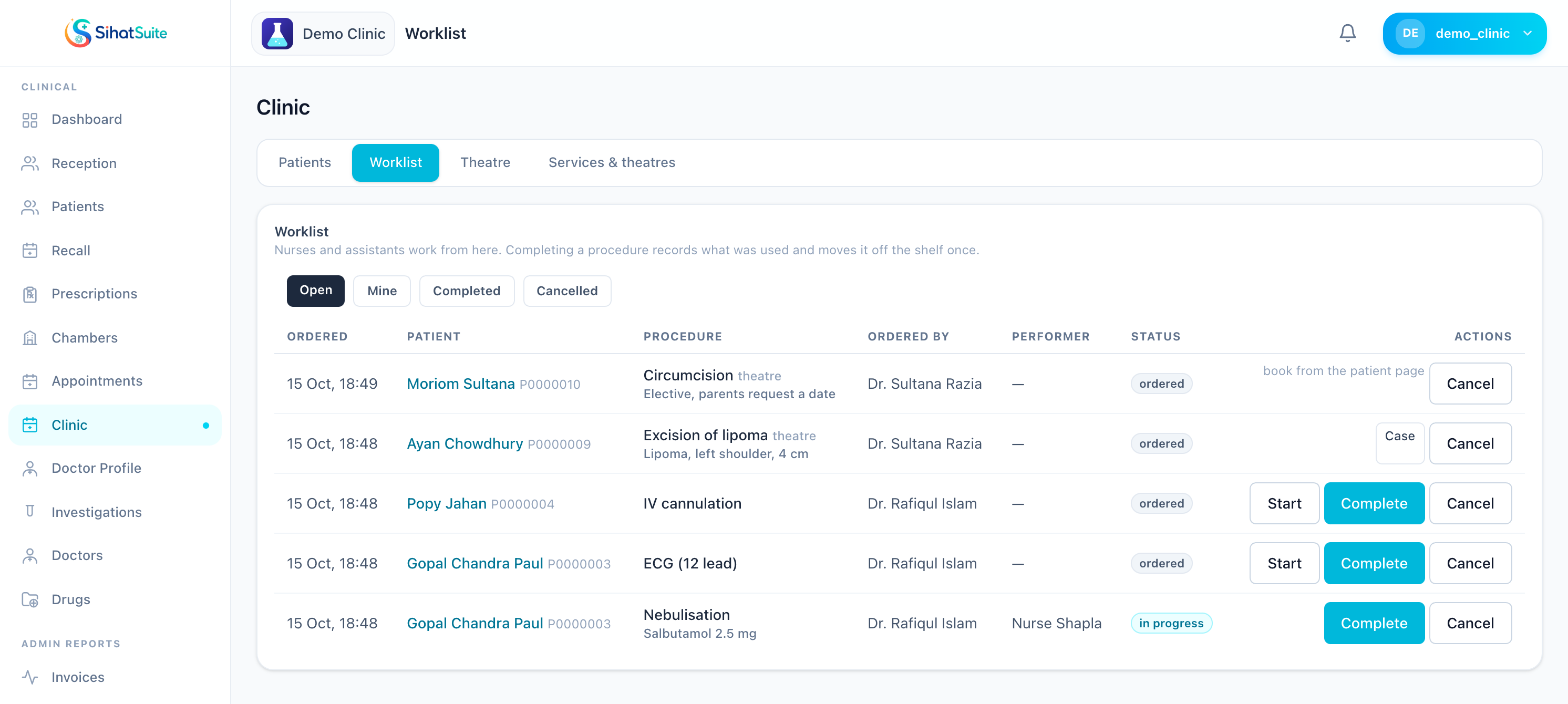
Each service plans its consumables — this many gloves, this syringe, this much gauze — and stock moves once, at completion, by what the nurse confirmed. A refund never puts a used syringe back on the shelf, and cancelling a bill only frees the work to be billed again. The consumables sit in the same stock the clinic buys from suppliers, so the shelf and the records agree.
The patient's clinic page
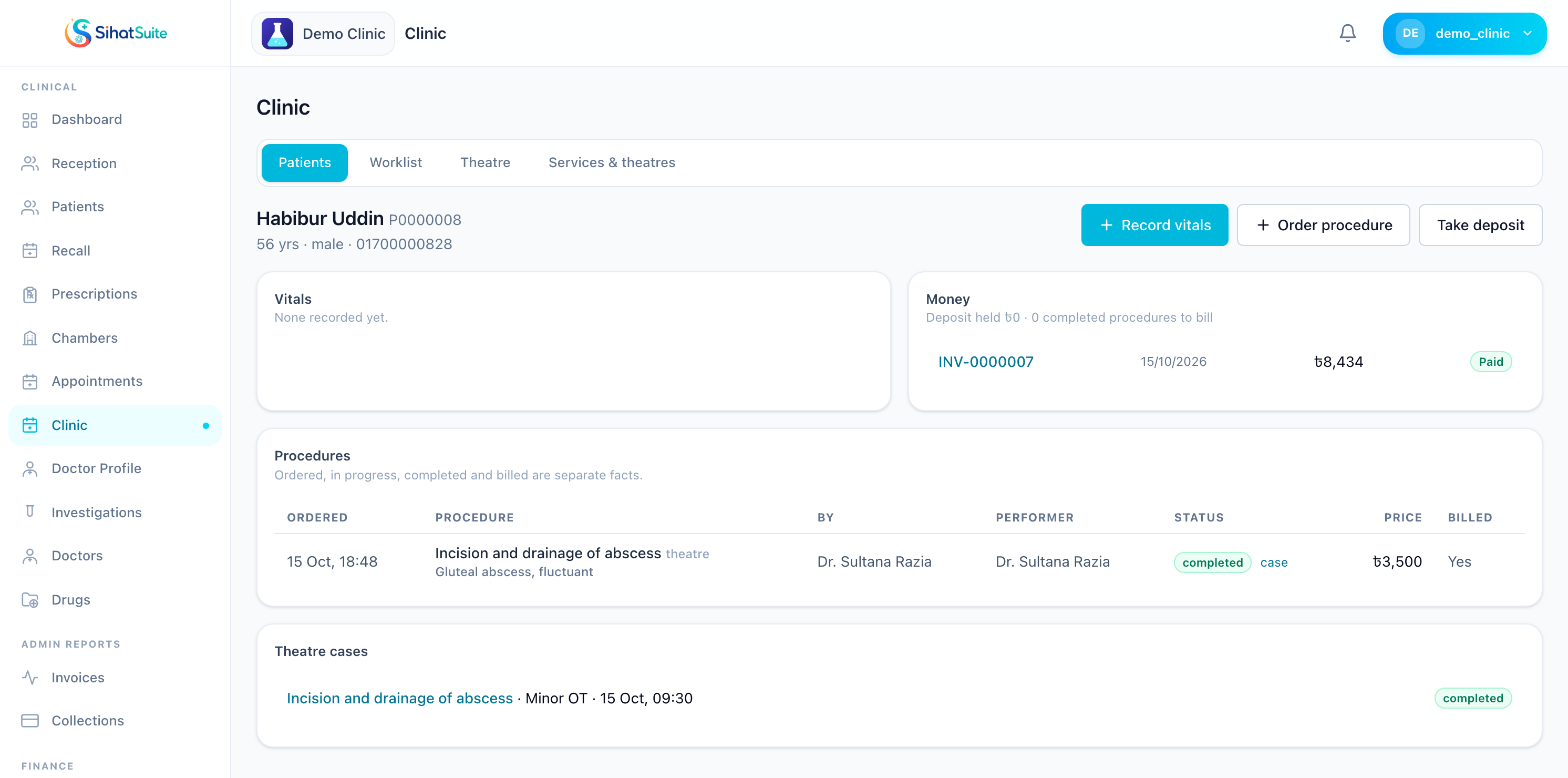
Every piece of a visit — the serial, the vitals, the prescription, the procedures, the theatre case, the bills — sits on one clinic page for the patient, with a single next step at the top. When something cannot go ahead, the page says what is missing and who owns it: consent not yet taken, a checklist item open, a deposit short. Before treatment the desk can print an estimate the patient takes home; the final bill shows where it differed. After a theatre case the patient leaves with a discharge pack: the operation note summary, the prescription and the follow-up serial.
A small day-care theatre
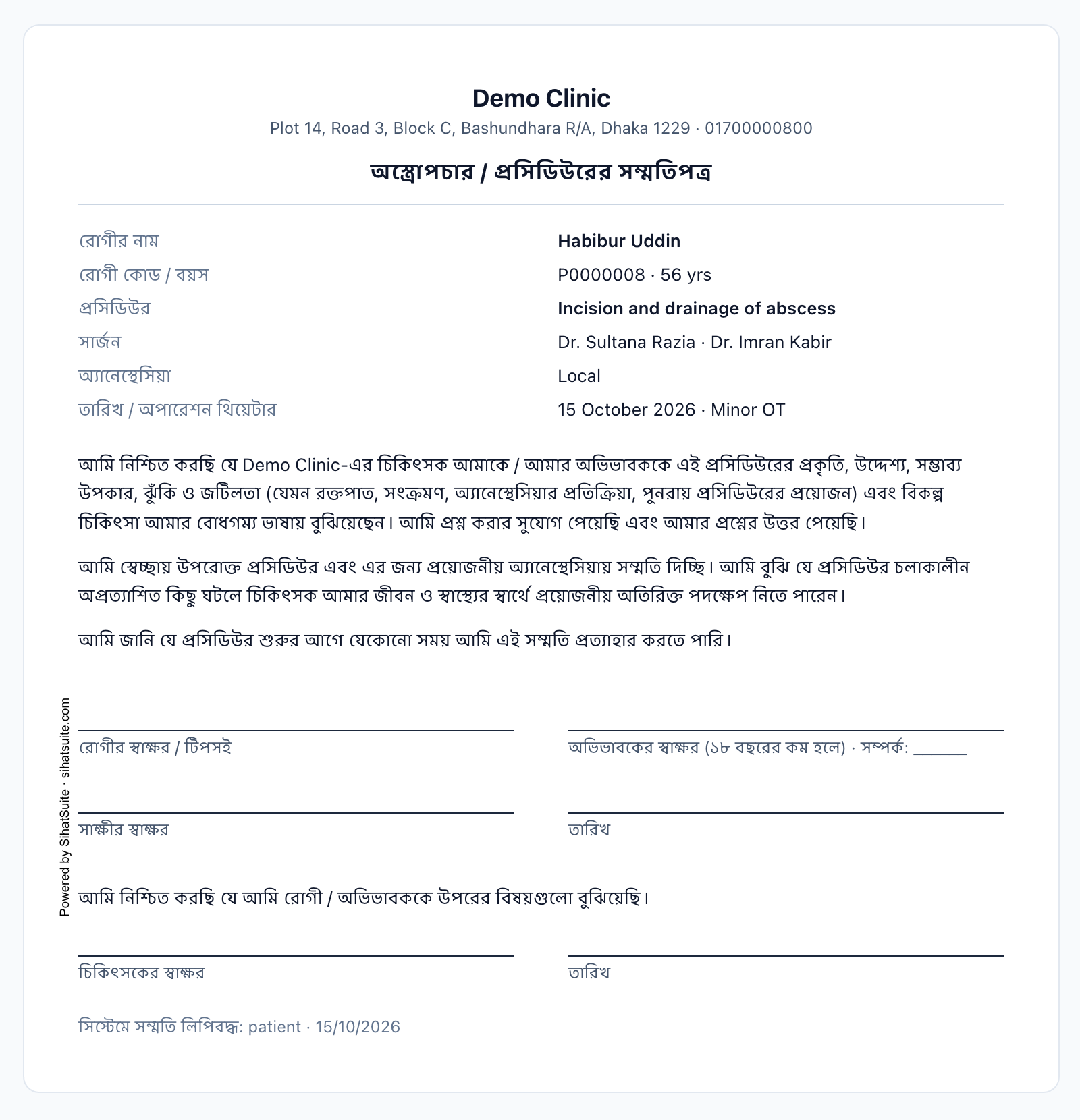
Theatre procedures get a case instead of a worklist line. The case is booked into a theatre room without overlap, with its surgeon, anaesthetist, assistant, start time and duration. Consent is recorded on the case — a guardian's for anyone under 18 — and prints in Bangla or English on the clinic's own paper. A fixed pre-op checklist is ticked item by item, with the time and the person recorded. The surgeon writes and signs the operation note; a signed note is never edited, and a correction sits beside the original. Recovery observations are logged until the patient leaves, and the case is completed.
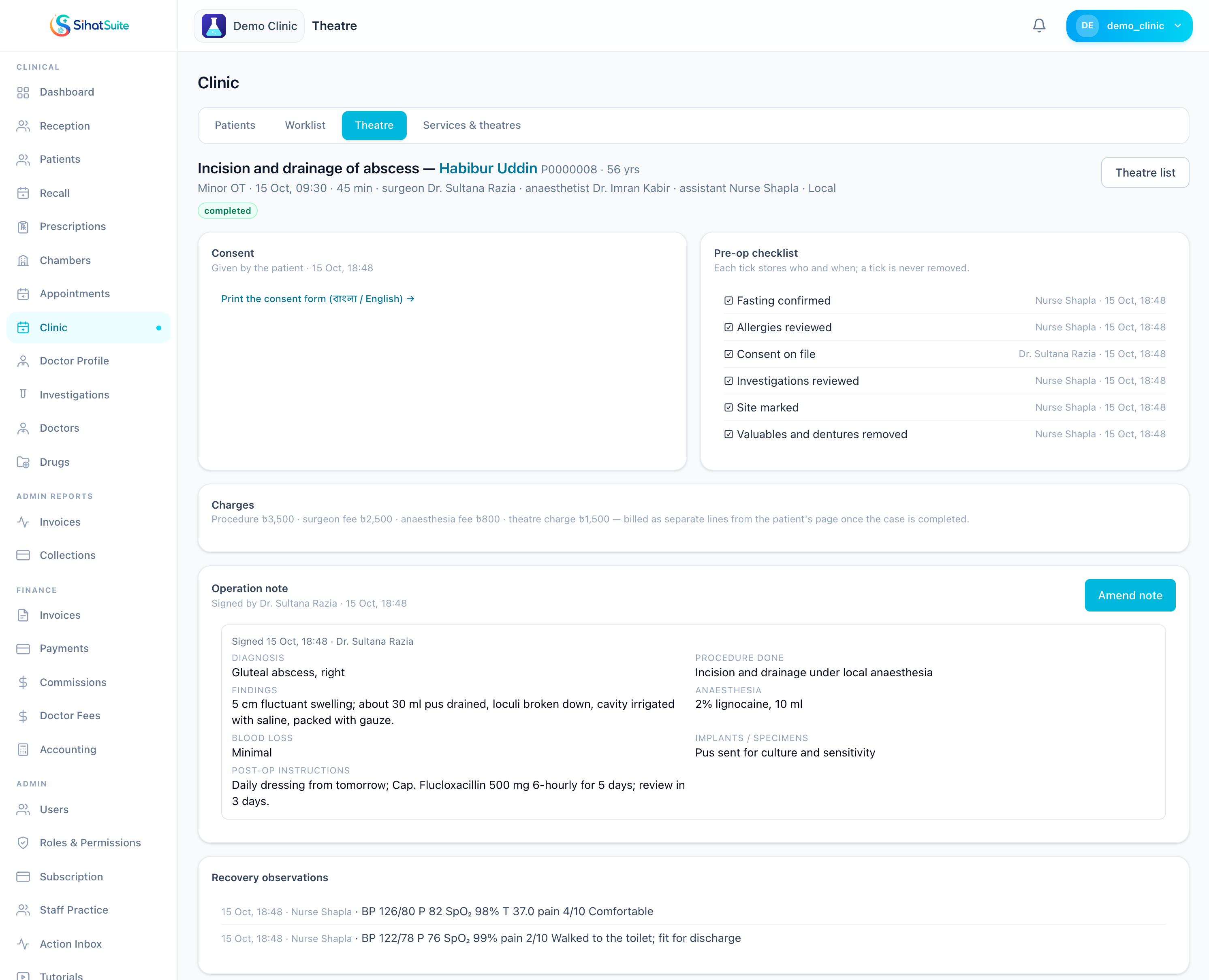
The theatre list is the register: every case by day and room, with its consent, checklist, note and observations attached. Nobody has to keep the notebook as well.
Bills that read the way clinics quote
A clinic bill lists the procedure, the surgeon's fee, the anaesthesia fee, the theatre charge and the consumables at cost as separate lines, because that is how a clinic quotes and how a patient's family checks the total. A deposit taken before the case is held as the patient's credit and drawn first; the rest is paid by cash, card or mobile banking. The surgeon's and anaesthetist's fees flow into the same settlement as consultation fees, so each doctor's statement shows their theatre work beside their chamber visits.
What is not in it
- Beds, admitted patients, nursing shifts and running inpatient bills. Clinic Management is for patients who go home the same day; inpatient care is a separate product we are scoping.
- An anaesthesia chart, instrument sterilisation tracking, an implant registry or a blood bank.
- Online payment of fees or deposits: money is taken at the desk.
What it costs
As of October 2026, Clinic Management is ৳3,000 a month, with the prescription pad, the waiting-room TV and fifteen doctor logins included. A clinic that also runs a lab adds Diagnostic Management for ৳4,500 in all, a clinic with a medicine counter adds Pharmacy for ৳4,000, and both together are ৳5,500. A clinic with neither uses the package as it is. SMS and WhatsApp message credits are separate, and the web application needs an internet connection.
Related resources
Keep reading
Solutions: Diagnostic management software · Clinic management software · Doctor consultancy software · Prescription software · Pathology lab software · Pharmacy software · Physiotherapy & counselling software · Prescription + Pharmacy
Try SihatSuite with your own workflow
Start a free trial or book a demo — support in Bangla and English.