Running an Eye Hospital: From the Surgery Advice to the Final Review
An eye hospital rarely loses track in the consulting room. It loses track in the weeks after surgery is advised: whose work-up is pending, which lens the surgeon approved, which lot went into which eye, and who is due back for a review. Eye Hospital is built for those weeks.
Current packages and who they fit
Prices below match the current package catalog. Doctor serials come with any package that includes Eye Chamber or Optical Shop.
SihatSuite packages, current prices and intended workflows
For eye hospitals that operate and admit: Eye Care Centre with eye surgery from the waiting list to the outcome audit, the theatre, day-care seats, wards and the stay's bill.
Prefer to watch? The whole workflow on video (Bangla narration)
Eye Hospital
Eye Hospital — আপনিই চালান, বাংলা গাইড
চোখের হাসপাতাল নিজে চালিয়ে দেখুন: একজন ছানি রোগীকে ছয়টি ডেমো লগইনে এগিয়ে নিন — ডাক্তারের পরামর্শ, বায়োমেট্রি ও লেন্সের পরিকল্পনা, প্যাকেজ ও এস্টিমেট, ভর্তি ও চলতি বিল, থিয়েটারের চেকলিস্ট ও অপারেশন নোট, ওয়ার্ড, ফলো-আপ কার্ড আর রিভিউ। মাঝে তিনটি প্রশ্ন, শেষে ডেমোতে করার তিনটি কাজ।
An eye hospital in Bangladesh does two kinds of work under one roof. One is the chamber: vision and refraction, the examination, glasses, and often an optical counter. The other begins when the doctor says an eye needs surgery and ends weeks later at the final review. The chamber is a queue. Surgery is a list of things that all have to be true on the day: the work-up finished, the right lens on the shelf, a place on the theatre list, a seat or a bed, a bill the family was told about, and drops the patient can put in correctly at home.
The surgery waiting list is a register, so nobody can say at a glance who is ready, whose work-up is pending and who was postponed.
The biometry is on a printout and the chosen lens power is written beside it. When the plan changes, nothing makes the surgeon look at it again.
The lens comes out of the cupboard and is checked against memory, and its lot number is copied by hand, if at all.
The family hears one figure at counselling and sees another at discharge.
The patient goes home with three bottles of drops and a spoken instruction.
Nobody can say what last month's cataract patients ended up seeing, by surgeon or by camp.
Everything in Eye Chamber, first
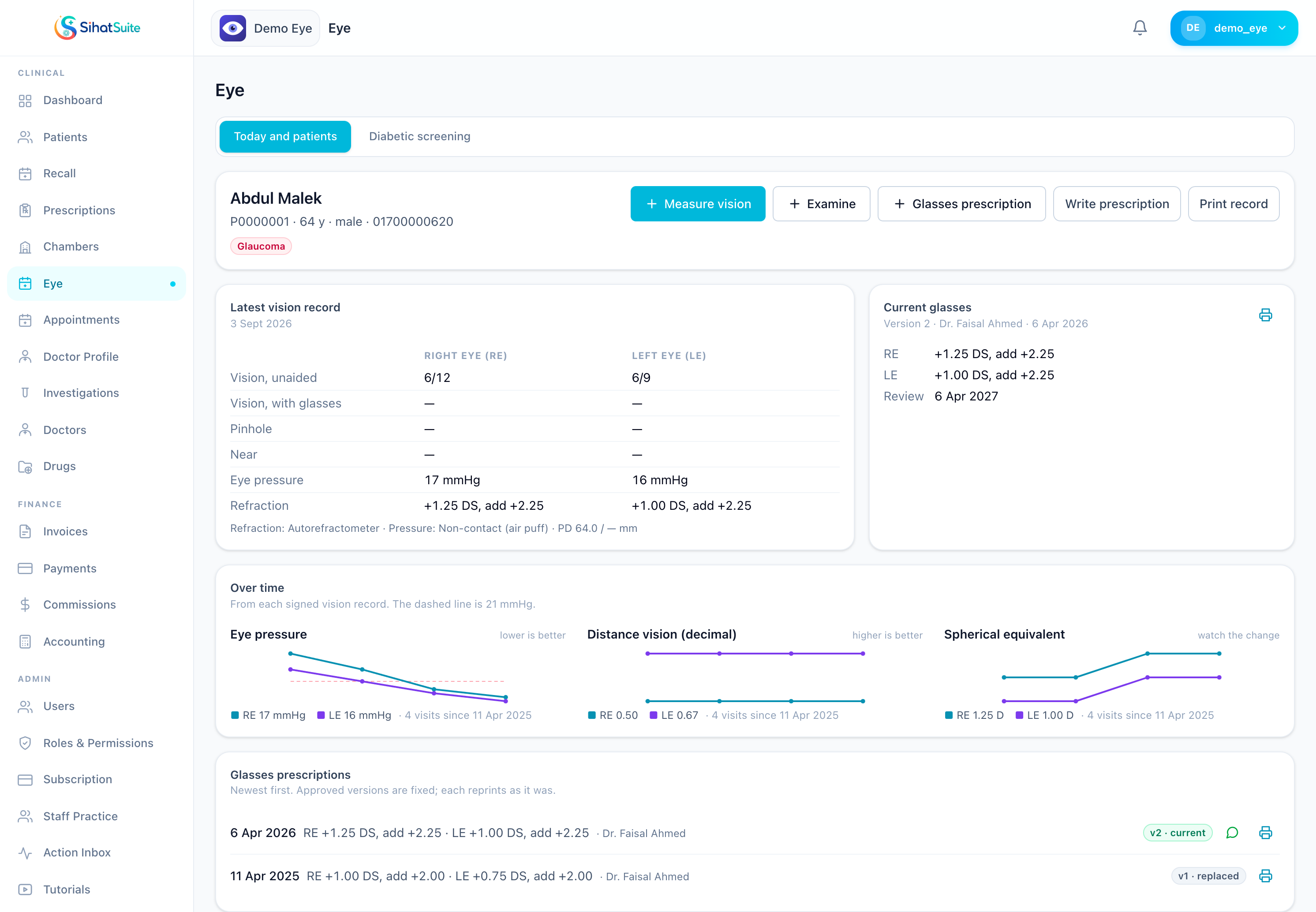
Eye Hospital includes Eye Chamber and the optical counter: vision and refraction recorded per eye, the eye examination, glasses prescriptions, the doctor's prescription pad and glasses orders. The surgery side is built on the same patient and the same eye record. The doctor advises surgery from that record, saying which eye and which operation, and the patient joins the surgery waiting list from there.
The eye record surgery is advised from, at a demo chamber. Every patient is invented.
A waiting list that says who is ready
The waiting list shows, on one screen, who is not fit, whose work-up is pending, who is ready and who is postponed. The counsellor gives the family the surgery package and its estimate. An operation that needs a lens or biometry is never booked for both eyes at once: the second eye is its own episode.
Biometry, the lens plan and the surgeon's approval
The technician records the axial length and keratometry for both eyes, and the software warns on unusual values. The lens and its power are chosen from what is in stock, and the surgeon approves the plan. Every revision is kept, and a changed plan needs the surgeon's approval again. Sugar and blood pressure are held to limits, fitness is recorded, and the anaesthetist signs off where general anaesthesia is planned. It is checked again as the patient goes in: if anything changed since the booking, the patient does not go in.
One thing the software deliberately leaves to the surgeon is the lens power itself. The biometer's values and the chosen power are recorded and approved; they are not computed.
Lens stock, and the lot checked at the table
Lenses are kept by model and power, each with its lot and expiry, and lots close to expiry stand out. In theatre, the lens lot and power are checked against the approved plan as part of the checklist, so the lens that goes in is the lens that was planned. After an operation with an implant, the patient gets an implant card to keep, with the model, power, serial and lot.
The theatre list, the checklist and the operation note
Cases go on a theatre list with their times, and a clash of surgeon or room is refused. Cataract (phaco and SICS), glaucoma, vitreoretinal, squint, oculoplasty, cornea and eye injections each have their own safety checklist, with the eye confirmed and marked and the lens verified, and their own operation note template. The consent form and the pre-operative instructions print in Bangla or English.
Day-care seats, wards and one bill for the stay
Many patients go home the same day and take a day-care seat; others take a ward bed or a cabin. A surgery package says what it covers, such as bed days, a lens allowance and the surgeon's share, and the estimate is printed from it. What is charged during the stay collects on one running bill. Where a sponsor pays part of an operation, the sponsor takes its set share of the patient's bill and that share is kept apart.
Discharge, and a drop chart the patient can follow
The discharge summary has its own eye section and is signed by the doctor. From the signed prescription the hospital prints a day-by-day tick chart of the eye drops, with the eye named in words and drawn, in Bangla or English. The patient takes it home, with a follow-up card that lists the review dates.
Follow-ups, outcomes and camps
Reviews fall due the next day, at a week, and finally at four to six weeks. The final vision goes into an outcome audit: final vision and complications such as PCR, by surgeon and by camp, with revenue reports beside it, all exportable to Excel. A camp shows how many people were screened, how many were advised surgery and how many were operated, and the reports split both outcomes and money by sponsor and by camp.
What is not in it
A lens power calculator is not included: it stays off until a clinician has verified it.
Storing OCT or fundus images is not included.
SMS or WhatsApp reminders for surgery are not included.
Lens consignment stock and insurance claims are not included.
Camp entry without an internet connection is not included.
A pharmacy or a lab is not included: a hospital whose own pharmacy or lab bills to the stay adds those separately.
A chamber, a centre or a hospital?
A chamber with no theatre or beds takes Eye Chamber: measurements, the examination, glasses prescriptions and the prescription pad.
A centre with an optical counter but no surgery takes Eye Care Centre: Eye Chamber and the Optical Shop together.
A hospital that operates and admits takes Eye Hospital: all of that, with surgery, the theatre, day-care, wards and the stay's bill.
Today's price of each eye package is in the table at the top of this article, read from the current catalogue. Eye Care Centre and Eye Hospital are built on the same patients and the same eye records as Eye Chamber, so a chamber that starts small does not start again when it adds a counter or a theatre.